
4.2 LLM Records
Every request an agent relayed through Gateway: the full system prompt, every message and tool call, the schema of every tool the model was offered, plus tokens and cost.
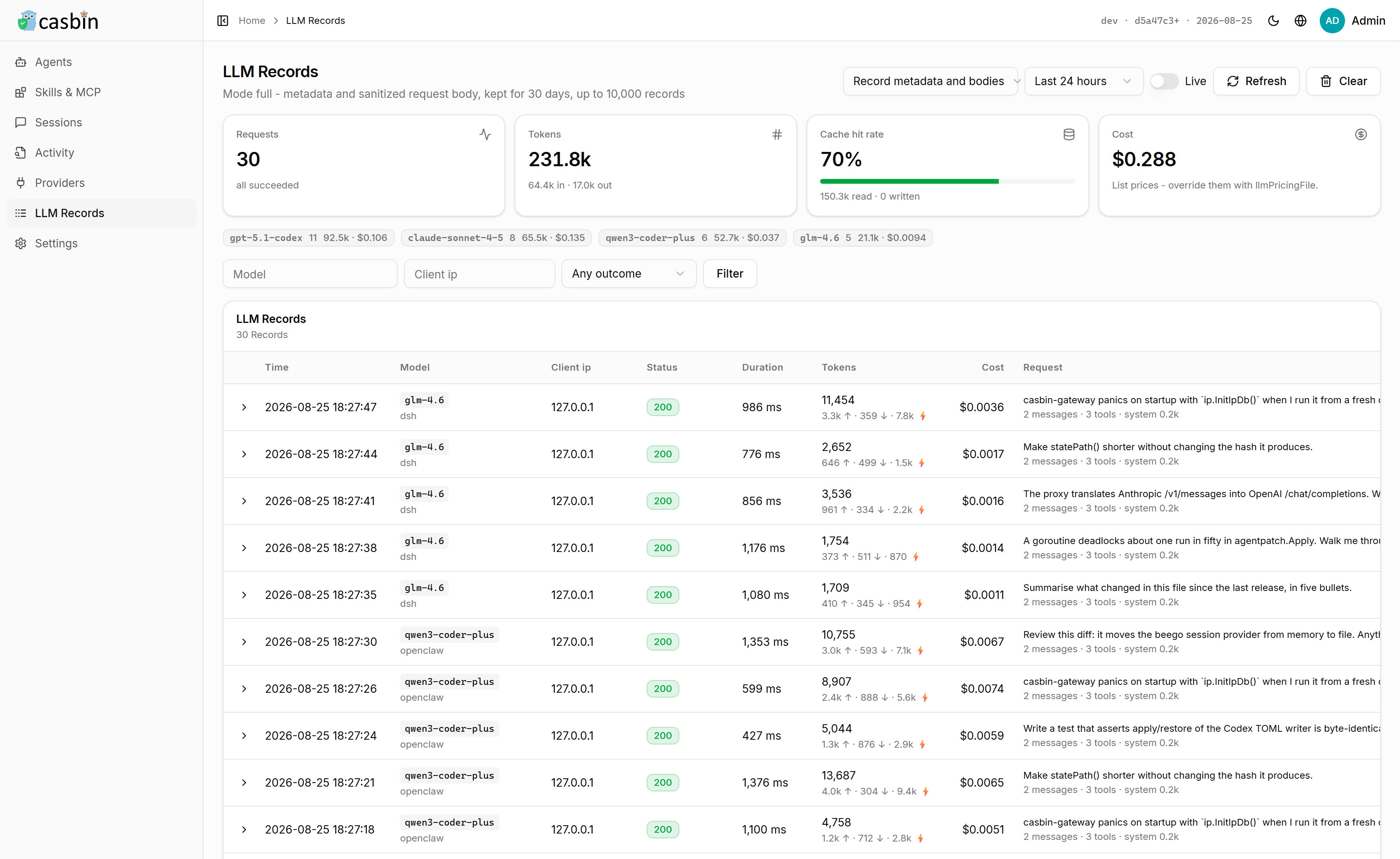
This is the page that answers "what did the agent actually send", which a token count never does.
Read this before you route an agent
Every relayed request is recorded in full from the first one, prompt included. None of it leaves this machine — but a prompt carries whatever was pasted into it, so if that is not what you want, change it first.
The picker at the top of the page has three positions, and so does Settings → LLM records:
| Mode | Kept |
|---|---|
Recording off (off) | Nothing |
Record metadata (metadata) | Who called which model, with which outcome |
Record metadata and bodies (full, the default) | The above, plus the request body — prompts, messages and tool schemas |
A change takes effect from the next request.
The limits around it
Seeded from conf/app.conf, changed on the Settings page:
llmRecordMode = "full"
llmRecordRetentionDays = 30
llmRecordMaxRecords = 10000
llmRecordMaxPayloadBytes = 1048576
What is not stored
- Request headers never reach a record at all, which is where the inbound API key is.
- Bodies are sanitized before they are stored: anything that looks like a credential is replaced, and the number of replacements is shown with the record.
- A body over
llmRecordMaxPayloadByteskeeps its structure and loses only its longest strings, so a large conversation is still listed message by message.
When the model asked for was not the model served
A request can be answered by a model other than the one the client named: a routing rule, or the downgrade taken when the model above it could not answer. The record of such a request carries Routed to, the name that actually went on the wire, and Routed by, the rule that chose it. Neither appears when nothing was routed.
Every attempt the request failed over from is listed with the provider, the model it asked for and why it did not answer, so a turn served by a lesser model says what was tried above it.
The cost column
Worked out from list prices, which vendors change and resellers do not follow, and priced against the model that was actually billed rather than the one the client asked for. Two ways to correct it:
- Edit the price on the Model pricing page (4.3).
- Point
llmPricingFileat a JSON file of your own rates.
Records against the other two pages
| Page | Covers | Source |
|---|---|---|
| LLM Records | Requests Gateway relayed | The proxy |
| Agent Records | Tool calls a monitored agent made | The monitoring hook |
| Agent Sessions | Whole conversations, routed or not | The agent's own transcripts |
Next: 4.3 Usage and model pricing.
4.1 Permissions
An agent can be given less than it came with, without editing its own configuration.
4.3 Usage and model pricing
An agent on its own subscription relays nothing through Gateway, and a request that goes straight to the vendor leaves no record here — but the agent writes a transcript of it on disk anyway.